Restraint as a creative decision
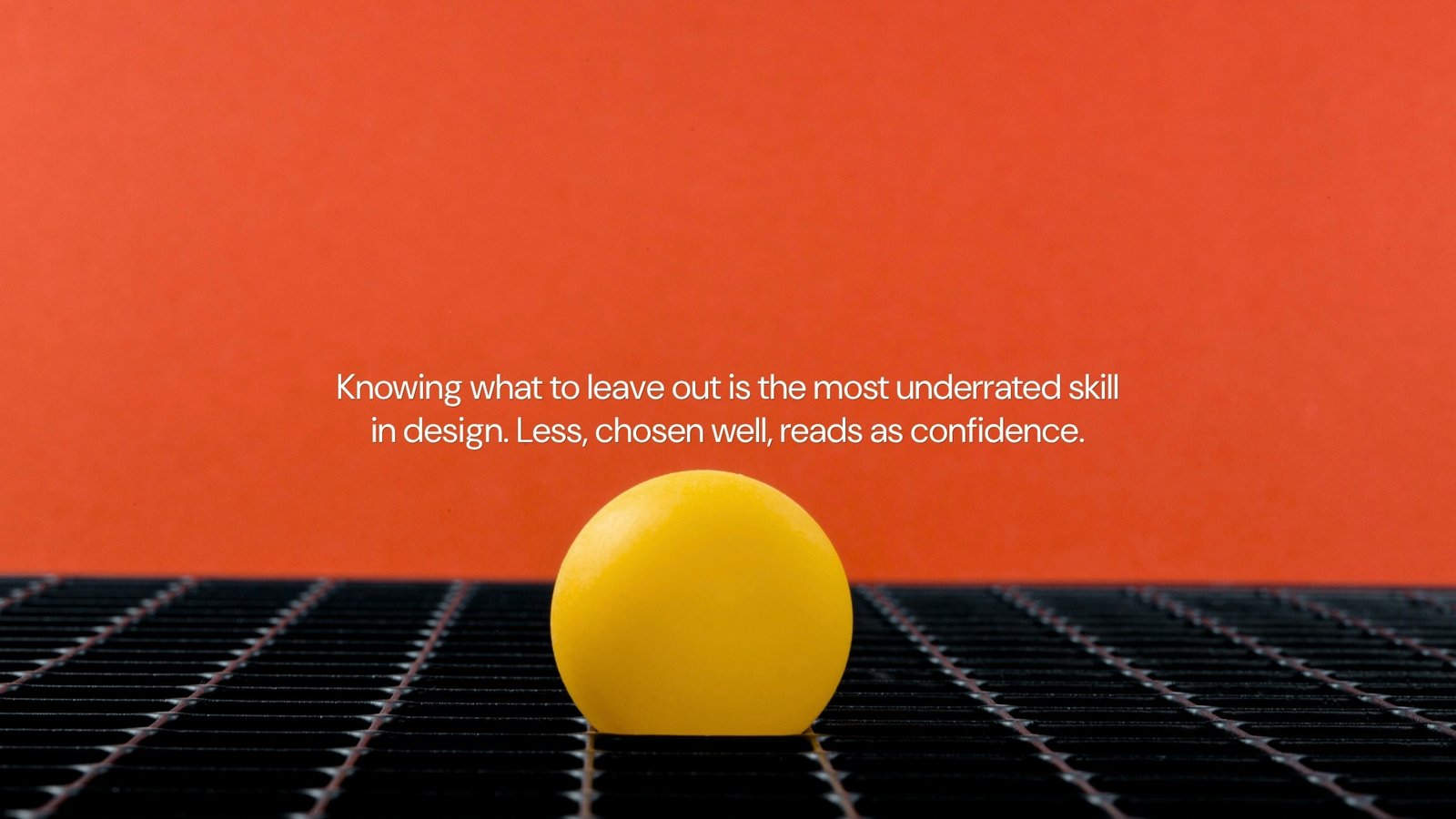
Restraint as a creative decision means deliberately leaving things out — an effect, a colour, a line of copy — not because there wasn't time to add them, but because the work is stronger without them. Knowing what to cut is a harder skill than knowing what to add, and it's the difference between design that looks confident and design that looks anxious.
More is the easy choice
Adding is always available: another animation, another colour, another line explaining the point in case it wasn't clear the first time. It requires no judgment call, and it feels like progress. Cutting requires someone to decide, out loud, that something good isn't good enough to keep — and to be right about it. That's why restraint is rare: it's simply harder than addition.
What restraint signals to the person looking at it
A page with one bold statement and a lot of white space reads as a brand that knows exactly what it wants to say. A page that says the same thing five different ways, with three colours and two competing fonts, reads as a brand that isn't sure — so it's hedging. Viewers pick up on this instantly and mostly unconsciously. Confidence is legible in what's missing as much as what's there.
Confidence is legible in what's missing as much as what's there.
Restraint is a decision, not an accident
This isn't an argument for minimalism as a style, or for cutting things randomly to look austere. Restraint only works when it's the result of a real choice: this element earns its place, that one doesn't. The test isn't “does this look empty” — it's “does removing this make the message clearer or weaker.” If the message survives without it, cut it. If it doesn't, it wasn't decoration, it was necessary.
Where to practice it first
- The headline: if it needs a second sentence to explain itself, the first one isn't done
- The palette: pick the one accent colour that matters, and make everything else support it
- The homepage: cut every section that exists because it “should” be there, not because it earns attention
- The brief: state the one thing the audience needs to remember, and resist listing five
The next time a design feels like it's missing something, check whether it's actually missing confidence in what's already there.
Frequently asked questions
Isn't restraint just another word for minimalism?
No — minimalism is a visual style. Restraint is a decision-making habit that applies to any style, including maximalist ones. It's about earning every element's place, not about how few elements there are.
How do you know when you've cut too much?
When the core message gets weaker, not just simpler. If removing something makes the point harder to understand, it wasn't excess — it was doing work.
Want this kind of thinking on your brand?